
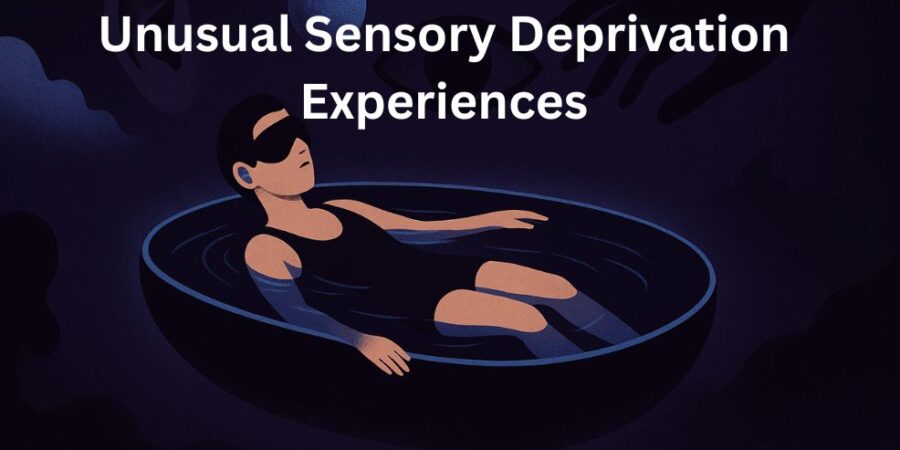
Sensory deprivation means intentionally limiting or removing one or more senses – sight, sound, touch, smell or taste – to create an environment very different from our everyday sensory overload. Most people have heard of floatation tanks or wearing a blindfold in darkness, but there are far stranger and more immersive ways to strip away the usual input. By exploring these unusual deprivation experiences, you can uncover new levels of relaxation, creativity, and self-awareness. In this post we’ll describe ten unique sensory deprivation adventures (beyond the common float tanks or blindfold games), discuss general benefits and drawbacks, and explain how such experiences can ultimately make life better.
Potential Benefits of Sensory Deprivation: Practitioners of all types report that giving the senses a rest can bring a variety of positive effects. Many people emerge feeling deeply relaxed and stress-free, almost as if their mind took a mini-vacation. With external distractions cut off, the mind often turns inward, helping to sharpen focus, ignite creativity, and encourage new insights. In quiet, dark, or still settings one may notice subtle thoughts and feelings more clearly, aiding self-reflection or even sparking creative ideas that might never surface in a busy environment. Physically, relieving sensory “noise” can calm the nervous system: muscle tension often melts away, heart rate slows, and anxiety levels can drop. Some users find these retreats boost their mood (a post-experience “glow” of endorphins), improve sleep, and even ease chronic aches through relaxation. Athletes and therapists have pointed out that this deep rest and neurochemical shift can help with pain relief and faster healing, since the body and mind are freed from constant alarms and stimulation.
Potential Drawbacks: While many find deprivation soothing, it can be unsettling for others. Complete darkness or silence can trigger anxiety, panic, or even claustrophobia in some people. In an echo-free chamber or pitch-black room, your own heartbeat or breathing may suddenly seem unnaturally loud, which can be disorienting. A common effect of deep deprivation is unusual hallucinations or vivid daydreams as the brain “fills in” missing stimuli; these can be enlightening or purely bizarre, but they can also alarm someone who isn’t prepared. For anyone with certain medical conditions (like epilepsy, severe mental health issues, or heart problems), these experiences might exacerbate symptoms, so caution is important. The lack of sensation can also become physically uncomfortable – for example, lying still for hours in a dark cave retreat might cause cold, numbness, or restlessness. Because some deprivation experiences involve tight enclosures or binding, there are risks of circulation issues or panic; expert supervision and clear safety signals are always recommended in extreme cases. In short, sensory deprivation isn’t magically harmless for everyone – it demands the right setting, support, and mindset to be beneficial.
10 Unusual Sensory Deprivation Experiences
- Darkness Retreats (Complete Light Deprivation): Spending hours or days in total darkness is a deep sensory reset for your vision. In these retreats you enter a windowless, light-proof room (often a small cabin or cave-like space) and avoid any electronic lights. Even the smallest glow – from a phone, clock, or candle – is carefully eliminated. Over time your eyes adjust and you become blind to yourself and your surroundings. Pioneered by Tibetan yogis centuries ago, modern dark retreats (like the Sky Cave retreats in Oregon) have grown in popularity. Participants often report that after a period of initial panic or unease, profound changes occur. Without visual input, the mind can “see” memories and fantasies as vivid hallucinations once thought triggered only by hallucinogens. Colors and shapes may swirl behind your closed eyelids, or you might relive past scenes with intense clarity. Many people describe the darkness as “alive,” and emerging from it feels like being reborn into the light. The benefits can include heightened introspection, emotional breakthroughs (for example, suddenly gaining perspective on a personal problem or feeling unusually at peace with past events), and a renewed appreciation for everyday sights when normal light returns. On the downside, no-light retreats can be deeply scary, especially at first. The utter blackness can trigger instinctive fear (our brains are wired to feel vulnerable without sight). Practitioners advise beginners to go slowly – starting with a few hours of darkness or having a guide check in – so the darkness doesn’t overwhelm. Those who commit to multi-day darkness retreat often emerge reporting a sense of mental “shedding,” but it requires courage and trust to surrender fully to such an intense absence of light.
- Silent Meditation Retreats (Complete Sound Deprivation): While not as sensational as total darkness, utter silence is also rare in modern life. In a silent retreat (often monastic or mindfulness-based), participants refrain from speaking, listening to music, using devices, or sometimes even reading or writing. Sometimes silence retreats also forbid eye contact and media, creating a muffled, still environment. Without speech or music, you notice more of your body and thoughts. Sensitive sounds that usually go unnoticed – your own breath, the ticking of a distant clock, or the hum of the air – become apparent. Many meditators find that prolonged silence leads to surprising mental clarity and creativity. Freed from chatty everyday communication, the mind can focus deeply on a mantra, breathing, or simply observing thoughts. Veterans of silent retreats often say that long periods of silence feel like peeling away layers of noise in the mind. Practically, a silent retreat might involve dedicated meditation practice for hours each day, supported by instructors who also remain mostly silent. Benefits include reduced internal chatter (the “monkey mind” quiets down), emotional release (people sometimes find they can cry without judgment), and insight – similar to the darkness retreat but with calm light. The drawbacks are that not all personalities find silence comforting. Extended silence can bring repressed emotions to the surface, which is therapeutic but can feel intense or “psychotic” to those unprepared. A common rule is to have a teacher or buddy check in, so feelings of isolation don’t turn into anxiety. Unlike darkness retreats, silence alone usually doesn’t cause hallucinations, but it can make one extremely sensitive to any accidental noise or annoyance (a sudden cough or insect buzz in a quiet hall can feel disproportionately startling).
- Full-Body Encapsulation (Mummification / Vacuum Bed): Imagine being totally immobile and swaddled, unable to feel anything except pressure against your skin. That’s the essence of this tactile deprivation. In various communities (often BDSM or sensory therapy contexts), people lie on a special bed or wear a suit that encases their body. For example, a vacuum bed is a latex sheet that, when the air is sucked out, vacuums tightly around every curve of your body. Similarly, full-body “mummification” using plastic wrap or specially sewn suits can fully restrict movement. The initial feeling is like being buried or hugged by the world – your skin feels nearly numb under even pressure, and you are literally unable to scratch, wiggle, or turn. Mindfulness enthusiasts might seek this to experience deep stillness. The benefits reported include an almost sedating sense of calm. With your body unable to move, the mind has nothing to do but settle. Many describe a slow, meditative sensation, as if time stretches longer; anxious thoughts often quiet down on their own when the body cannot act on them. Some find this state emotionally soothing, especially neurodivergent people who feel overstimulated by normal sensations – the uniform pressure can be as comforting as a weighted blanket but taken to an extreme. This stillness can foster deep trust if done with a partner or guide, since you have to rely on someone to release you. On the other hand, the drawbacks are evident: even in playful or therapeutic settings, being completely immobilized can trigger panic or claustrophobia. It can make one feel vulnerable or hyper-aware of breathing and heartbeat. Physically, risks include overheating (the latex traps heat) and circulation issues if done too long or too tight. For this reason, safety measures (like a clear signal to cut off the wrap or stop the vacuum) are crucial. In a safe setting, though, many people find it refreshing to experience their body purely as sensation- but-without-action, leading to new mind–body insights.
- Sensory Deprivation Suits (Full-Body Suits or Helmets): Beyond being wrapped in place, another approach is wearing a special suit or helmet that dulls multiple senses at once. For instance, a “sensory deprivation suit” might be a one-piece garment covering from head to toe in a thick, uniform fabric. A helmet or hood may have dark lenses and noise-cancelling earmuffs built in. The goal is similar to full encasement but with a bit more comfort or mobility: you might still sit up or move arms slightly, but your vision is shrouded, sounds are muffled, and your limbs feel pressure from the snug fabric. Actors and alternative therapists have sometimes experimented with this for insight. Wearing such a suit, people often notice sharp colors turning to a monotone gray under their hidden eyes and external noises fading away, leaving only faint muffled echoes or even silence. Mentally, it can produce a dreamlike state: with sight and sound cut off, the brain creates its own visuals (like closed-eye hallucinations) and inner monologue fills the quiet. Some performers use it as a novelty to experience disorientation, or meditators use it to train focus. The benefits overlap with dark/silent retreats: you often feel more “in tune” with internal thoughts or the few permitted senses (touch, proprioception). Some say it enhances empathy by providing a hint of how isolating being disabled of senses feels. On the downside, it can be very uncomfortable: any itch or pain becomes magnified because you can’t adjust or scratch it easily. Also, like full encasement, these suits can make even gentle breathing feel loud in your own ears. It’s crucial to have such sessions time-limited and supervised.
- Anechoic Chamber (Total Echo-Free Environment): An anechoic chamber is a room designed to absorb all sound and block external noise. You literally hear nothing but your own body sounds: heartbeat, blood flow, the wheezing of your lungs, perhaps even the faint rustle of clothing. These chambers are sometimes found at universities or tech companies (for testing devices without echo). Few people have experienced them, because long exposure can be disconcerting. Entering an anechoic chamber is like stepping into a vacuum of sound. Initially, people often feel calm or peaceful – the absence of annoying office buzzes or traffic is delightful. But after a few minutes, many start to notice internal rhythms. Thoughts may even become visual images as the brain compensates for missing auditory input. People have reported hearing internal music or voices that weren’t there. It’s said to be a profound lesson in how much we rely on background noise to orient ourselves. The benefits can include intense meditative calm or an oddly “floaty” sensation of being disconnected. However, the drawbacks are significant: some report nausea or headaches from the unnatural silence, or panic if it feels too much like isolation. For this reason, sessions are often kept under 30 minutes if someone is new. In essence, anechoic chambers force you entirely inward – a possible gateway to deep self-awareness or, if that overwhelms you, a disorienting grind on the nerves.
- Pitch-Black Art Installations: Artists have built immersive environments to simulate extreme sensory reduction. One famous example is “SUB” by Kurt Hentschläger (shown at festivals and museums). In this installation you enter a completely dark room with ambient sound, and every so often the lights flicker with abstract patterns. For a moment the dark is broken by blinding flashes of fractal colors and shapes that dance wildly on your retina, then darkness returns. As you stay, you lose track of time and even your location, drifting in a semi-hypnotic state between flashes. In the darkness, after-images and strange visions linger in your mind. Another installation might be a fully dark cinema or gallery room with only minimal tactile cues. These art spaces allow you to sample extended deprivation in a structured way: the experience is novel and somewhat controlled by the artist’s timing of stimuli. Benefits of such installations include intense focus on one’s inner visions and emotions. Like meditation, they can be calming; like a roller-coaster, they can be thrilling. Some report feeling dislocated from their body, almost floating between reality and dream. The drawbacks are that people who dislike surprises or loss of control might find it jarring. (Imagine an unexpected light jolt after hours of darkness – it can be a shock to the system.) Yet for many visitors these installations are profoundly moving, illustrating how a lack of sensory information can make even a tiny spark of light feel miraculous. They also show how flexible our perception really is: in almost total sensory absence, the mind keeps us company with vivid imagination.
- Underwater Night Dive (Low Sensory Submersion): Staying still underwater (for example, floating face-down in a calm, dark pool or swimming at night with a torch held off) can be a form of sensory deprivation. Beneath the surface your hearing is naturally muffled – you can barely hear anything beyond the whoosh of your own breathing – and your vision is limited by darkness and water. The sensation of being weightless in water adds to the effect, similar to a floatation tank. Some people explore this by snorkeling or diving in a quiet, pitch-black environment (perhaps a cave dive or a night-time swim). In such conditions, the usual landmarks (the land around you, the sky above) vanish. You may feel detached from gravity and sound. The benefit is a profound sense of calm and detachment: many people say underwater darkness makes them feel like they’re floating in space. Thoughts can come in slow motion; movements are gentle and deliberate. However, safety is paramount – being underwater inherently carries risks. Divers must be very experienced and always have a guide or buddy, because the deprivation of sound and vision can be disorienting. Also, prolonged underwater buoyancy can make your ear and sinus pressure noticeable, which is an uncomfortable “drawback.” For those prepared for it, though, nighttime snorkeling or silent floating at the surface can feel like swimming in a silent cosmos, dissolving everyday concerns.
- Digital Detox Retreat (Complete Technology Fast): Although not strictly sensory in the physical sense, a retreat that removes all screens, devices, and electronic inputs is like depriving yourself of very modern senses. By giving up the constant visual and audio stream of phones and computers, you enter a quiet, low-stimulation zone. Often these retreats take place in nature lodges, remote cabins, or meditation centers where there is no Wi-Fi and nobody checks email. The idea is that the pull of apps, notifications, and endless scrolling is as invasive to our minds as loud noise or bright lights. Without phones, people at digital detoxes often spend hours in silence or simple activities (reading a paper book, meditating, journaling, hiking alone). Many report an unexpected sense of freedom and clarity once the habit of checking devices is broken. They notice the sky, the breeze, and even conversations more deeply. This type of deprivation can improve focus and reduce anxiety (you’re not constantly alerted to social media drama or news). The drawback is that people tend to feel anxious or “withdrawal-like” in the first 24-48 hours – a testament to how addicted our brains have become to digital dopamine hits. But on the positive side, those who make it through often come away realizing how refreshing it is to exist without the digital buzz, and they may carry improved work-life boundaries back home.
- Solitary Confinement Simulation (Complete Social and Environmental Isolation): At the extreme end, some seek out the feeling of total isolation, akin to solitary confinement (though usually under safe, short-term conditions). This could mean staying alone in a remote cabin with no mirrors, no clock, and no contact with anyone (even no letters or messages). The space itself might be bare except for necessities. This is not recommended for most people, but some adventurers and researchers have tried controlled “self-imposed solitary” to push their limits of the mind. In effect, you remove social and sensory anchors – no people, no devices, no decorative stimuli. The result can be an intense internal journey. People in such isolation often say they start “talking to themselves” out loud or their sense of time warps dramatically. The potential benefit (for very stable individuals) is a forced confrontation with one’s core mind and fears; survivors may feel mentally tougher or highly creative afterward. The risk, however, is significant: extended isolation can lead to anxiety, depression, or disorientation. That’s why even voluntary solitary retreats usually limit time (a few days max) and often include a guide checking in through the walls. Experienced practitioners say that the key is having a very clear purpose and emergency plan before trying such a deep experience.
- Full Sensory Washout (Combined Stimuli Elimination): Finally, a truly unusual and extreme form is to try eliminating all senses at once in some combination. For example, one might lie in a completely dark room (eyes blindfolded or shuttered) and wear earplugs or noise-canceling headphones, effectively cutting off vision and hearing simultaneously. Some have even tried deep breathing or slight meditation to minimize bodily sensations. This extreme form of “all senses off” plunges you into a kind of void. People who endure this say the brain goes into a sort of free form: without anchors, the mind may start dreaming with eyes open, recall distant memories vividly, or create entirely new images and stories. It’s like a blank canvas that the subconscious can paint on. The advantages are maximal relaxation of the sensory systems and a strong feeling of being inside one’s own head only. But again, this is only for those truly ready: the shock of losing multiple senses at once can produce intense panic or bizarre hallucinations. One way to try a mild version of this is simply to lie in a comfortable bed with an eye mask and keep earplugs on in a quiet room. Even that limited approach can be very powerful and is often used by insomniacs or anxious thinkers to achieve rest.
How These Experiences Can Make Life Better
These unusual sensory deprivation adventures are not just quirky party tricks – they can actually translate into everyday benefits. First, they remind us what it’s like to live without a constant overload of inputs. In modern life our senses are almost always busy: scrolling social media, pinging emails, background music, bright screens, noisy streets. Taking a break from that barrage lets your nervous system reset. Many people return from a sensory retreat with lowered baseline stress and a clearer head, which helps them handle daily pressures more calmly.
Second, these experiences often supercharge mindfulness. When you’ve spent hours focusing only on your breath or the faint feel of a blanket on your skin, you learn how easily attention can wander. Back in ordinary life, you may find yourself more easily able to concentrate on a single task or simply notice small joys you would have overlooked (a nice breeze on your face, or the flavor of a meal).
Third, forcing the brain into new situations often sparks creativity. That same emptiness that some find scary can become fertile ground for new ideas. Artists, writers, and scientists sometimes use solitude and quiet retreats to break through creative blocks. Without the usual input, the mind starts to connect dots in novel ways. People report leaving dark or silent retreats with “aha” insights about life decisions or inspiration for creative projects that seemed impossible amidst everyday distractions.
Fourth, these practices can teach resilience and self-sufficiency. Enduring discomfort – whether it’s fear of the dark, boredom, or the urge to reach for your phone – builds mental discipline. You learn that you can be okay without constant comfort or entertainment. This often leads to greater confidence: if you survived 82 hours in a dark bunker, facing a stressful Zoom meeting or a long traffic jam may feel much more manageable!
Finally, and perhaps most simply, sensory deprivation experiences remind us how amazing our senses really are when they come back on. Emerging from total silence might make music sound heavenly again; after a few days in the dark, colors burst to life when you see sunlight. These refreshed perceptions can translate to increased gratitude – suddenly you might relish the rustle of leaves, the chirp of birds, the smell of rain or fresh bread, and even the busy hum of a city as reminders of life. In this way, a dose of deprivation helps you re-appreciate the normal world.
In short, taking an unusual sensory break – whether by plunging into darkness, silence, weightlessness or stillness – can be a powerful reset. It pushes us out of autopilot and into presence. While such experiences can be intense and are not suited to everyone, many find them deeply rewarding. If approached safely and with an open mind, these adventures can reduce stress, boost creativity, and give fresh perspective – making daily life feel a little richer and less frantic in return.

Leave a Reply